
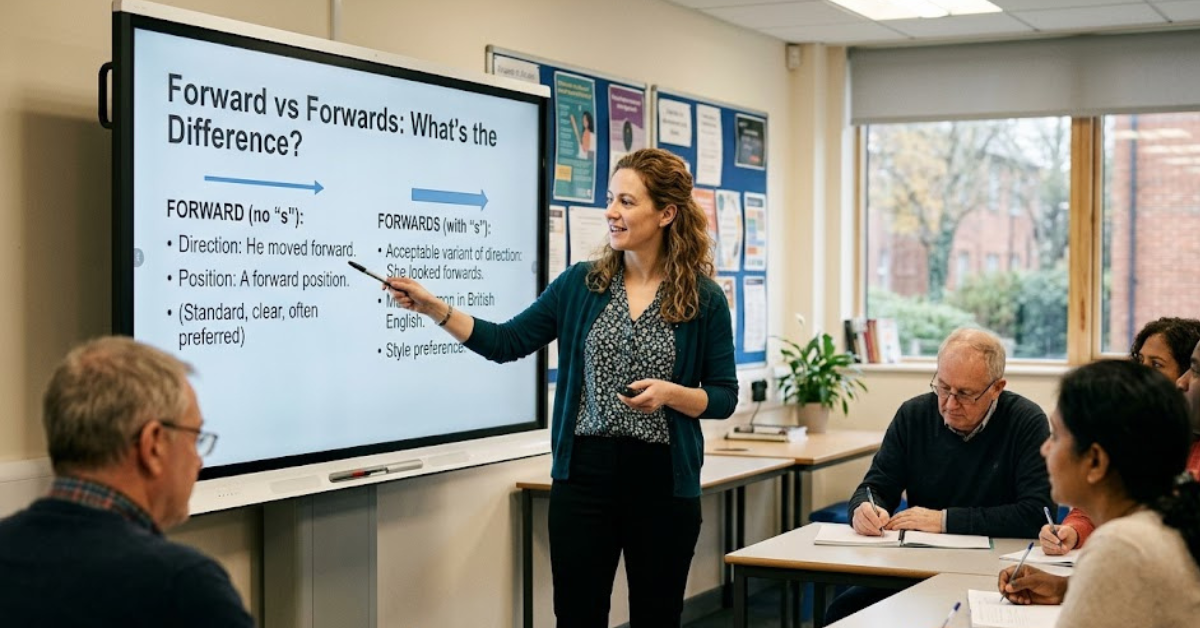
Have you ever stopped while writing and wondered whether you should use forward or forwards? You’re not alone. This is one of those small grammar questions that can cause surprisingly large amounts of confusion, especially because both words appear frequently in everyday English.
Understanding forward vs forwards is important for clear communication, whether you’re writing an email, preparing a report, or simply trying to improve your grammar. While the two words often mean the same thing, there are subtle differences in usage depending on context, style, and regional preferences.
In this guide, you’ll learn when each form is appropriate, how British and American English differ, and which version sounds most natural in common expressions.
What Do Forward and Forwards Mean?
Both forward and forwards function primarily as adverbs, meaning they describe movement toward the front or in the direction ahead.
For example:
- She stepped forward.
- She stepped forwards.
In many situations, both sentences are considered correct and carry the same meaning.
The confusion arises because English has developed different preferences over time, particularly between American and British English.
Forward vs Forwards Grammar Explained
When discussing forward vs forwards grammar, the key point is that both words can act as adverbs meaning “ahead” or “toward the front.”
Examples:
- Move forward carefully.
- Move forwards carefully.
- The team pushed forward despite challenges.
- The team pushed forwards despite challenges.
However, forward has a wider range of grammatical uses. It can function as:
- An adverb
- An adjective
- A noun
- A verb
Examples:
- A forward-thinking company. (adjective)
- The soccer forward scored twice. (noun)
- Please forward the email. (verb)
By contrast, forwards is almost exclusively used as an adverb.
This makes forward the more versatile option.
Forward vs Forwards UK Usage
One of the biggest differences appears when comparing regional English varieties.
British English
In the United Kingdom, both forms are commonly used. Many British speakers naturally say:
- Walk forwards.
- Look forwards.
- Step forwards.
The version ending in “s” often sounds slightly more conversational and traditional in British speech.
American English
In the United States, forward is overwhelmingly preferred.
Americans typically write:
- Move forward.
- Look forward to hearing from you.
- Step forward.
While forwards is still understood, it may sound less natural to many American readers.
As a result, most international style guides recommend using forward if you’re writing for a global audience.
When to Use Forward vs Forwards
If you’re wondering when to use forward vs forwards, the simplest rule is this:
Use forward in formal writing and professional communication.
Use forwards mainly when following British English conventions or matching a conversational tone.
Choose Forward When:
- Writing business documents
- Creating academic content
- Following American English standards
- Using the word as a noun, adjective, or verb
Examples:
- We need to move forward with the project.
- Please forward the document to management.
- She has a forward-looking strategy.
Choose Forwards When:
- Writing in British English
- Mimicking natural spoken language
- Referring specifically to movement ahead
Examples:
- He leaned forwards in his chair.
- The children ran forwards across the field.
Looking Forward vs Forwards
A common question concerns looking forward vs forwards.
In modern English, the expression look forward to is the standard phrase.
Correct:
- I look forward to meeting you.
- We look forward to your response.
Uncommon or nonstandard:
- I look forwards to meeting you.
Although some British speakers occasionally use look forwards to, it is far less common in formal writing.
If you’re writing emails, letters, or professional messages, look forward to is almost always the safest choice.
Moving Forward vs Forwards
Another phrase that frequently causes uncertainty is moving forward vs forwards.
Both versions can be grammatically correct, but their usage differs.
Moving Forward
This is the dominant form worldwide.
Examples:
- Moving forward, we will focus on customer experience.
- The company is moving forward with expansion plans.
The phrase is often used figuratively to mean progress or future action.
Moving Forwards
This version is more common in British English.
Examples:
- Moving forwards, we must improve communication.
- The organization is moving forwards despite setbacks.
While acceptable, it appears less frequently in professional and international communication.
Common Expressions That Prefer Forward
Certain phrases have become fixed expressions over time and almost always use forward.
Examples include:
- Looking forward to
- Forward thinking
- Forward planning
- Forward momentum
- Pay it forward
- Step forward
- Bring forward
- Put forward
Using forwards in these expressions may sound unusual or incorrect to many readers.
Why Does English Have Both Forms?
The existence of both words comes from historical language development.
English once used many adverbs ending in “s,” including:
- Towards
- Afterwards
- Backwards
- Forwards
Over time, American English largely dropped the “s” endings, while British English retained many of them.
That’s why you’ll often see:
- Toward and towards
- Backward and backwards
- Forward and forwards
Neither version is inherently wrong. They simply reflect different language traditions.
Common Mistakes to Avoid
When choosing between the two forms, avoid these common errors:
Using Forwards as a Verb
Incorrect:
- Please forwards the email.
Correct:
- Please forward the email.
Using Forwards as an Adjective
Incorrect:
- She has a forwards-looking strategy.
Correct:
- She has a forward-looking strategy.
Mixing Styles Inconsistently
If you’re writing in American English, stick with forward throughout the document.
If you’re following British English conventions, consistency remains important.
Quick Summary
Here’s an easy way to remember the distinction:
- Forward works as an adverb, adjective, noun, and verb.
- Forwards functions mainly as an adverb.
- American English strongly prefers forward.
- British English accepts both forms.
- Fixed expressions usually use forward.
- Professional writing generally favors forward.
Frequently Asked Questions
Is forward or forwards correct?
Both are correct when used as adverbs meaning “ahead” or “toward the front.” The preferred choice depends largely on regional style and context.
Which is more common, forward or forwards?
Forward is more common worldwide because it is preferred in American English and frequently used in formal writing.
Should I say look forward or look forwards?
Look forward to is the standard and widely accepted expression in both professional and everyday English.
Is forwards wrong in British English?
No. British English commonly uses forwards, particularly in speech and informal writing.
Can forward be a verb?
Yes. For example, “Please forward this message to the marketing team.”
Is moving forwards grammatically correct?
Yes. It is grammatically correct and commonly used in British English, though moving forward is more widely used internationally.
Conclusion
The debate around forward vs forwards is less about right and wrong and more about style, region, and context. Both forms can indicate movement toward the front, but forward is the more versatile and universally accepted choice. It functions as an adverb, adjective, noun, and verb, making it the preferred option in most professional and international communication.
If you’re unsure which form to use, choose forward. It will sound natural to readers almost everywhere. For those writing primarily in British English, forwards remains perfectly acceptable in many situations, particularly in conversational language. Understanding these subtle distinctions will help you write with greater confidence and clarity.