Before diving into grammar rules, consider this: many English learners and even native speakers occasionally hesitate when choosing between “younger” and “youngest.” The two words look similar and both relate to age, but they serve different purposes in a sentence.
Understanding younger vs youngest is essential for speaking and writing English correctly. Whether you’re comparing siblings, classmates, coworkers, or historical figures, knowing when to use each term can make your communication more precise and natural. This guide explains the differences, grammar rules, examples, and common mistakes in a simple and practical way.
Understanding Younger and Youngest
Both words come from the adjective young, but they represent different degrees of comparison.
- Younger is the comparative form of young.
- Youngest is the superlative form of young.
English uses comparative and superlative adjectives to compare people, places, or things.
What Does Younger Mean?
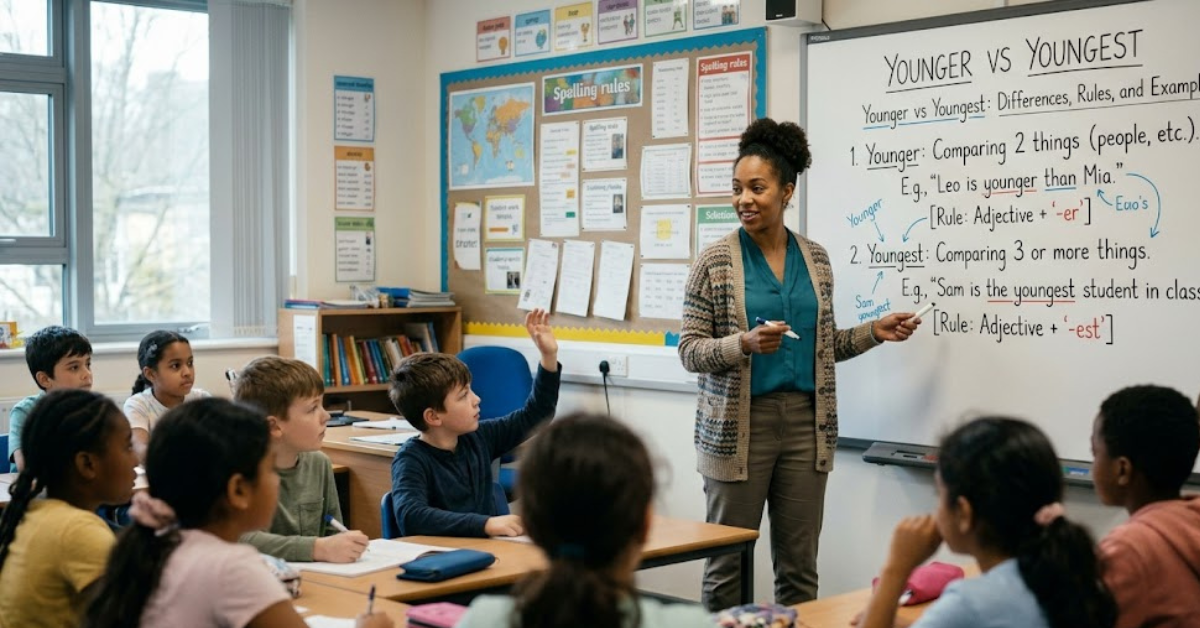
The word younger is used when comparing two people or things.
It indicates that one person has less age than another.
Examples:
- Sarah is younger than her sister.
- My brother is younger than me.
- This tree is younger than the one in the backyard.
In each example, only two subjects are being compared.
What Does Youngest Mean?
The word youngest is used when comparing three or more people or things.
It identifies the person or thing with the least age in a group.
Examples:
- Emma is the youngest child in the family.
- He is the youngest player on the team.
- Of all the candidates, she is the youngest.
Notice that the superlative form is usually preceded by the word the.
Younger vs Youngest: The Key Difference
The easiest way to remember the distinction is to focus on the number of items being compared.
Use Younger When:
- Comparing two people
- Comparing two animals
- Comparing two objects or entities
Examples:
- Jack is younger than David.
- This company is younger than its competitor.
- My cousin is younger than I am.
Use Youngest When:
- Comparing three or more people
- Identifying the lowest age within a group
- Describing rank based on age
Examples:
- Lily is the youngest of the three sisters.
- He became the youngest CEO in the company’s history.
- The youngest member of the committee spoke first.
Comparative and Superlative Adjectives Explained
To fully understand age comparisons, it helps to know how English adjectives change.
Here is a common pattern:
- Positive form: young
- Comparative form: younger
- Superlative form: youngest
Similar examples include:
- Tall → Taller → Tallest
- Small → Smaller → Smallest
- Fast → Faster → Fastest
The comparative form compares two subjects, while the superlative form compares three or more.
Common Sentences Using Younger
These examples show how comparative adjectives work in everyday English.
- My sister is younger than my brother.
- The new employee is younger than the manager.
- Their son looks much younger than his age.
- This generation is younger than the previous one.
A useful tip is that younger is often followed by the word than.
Common Sentences Using Youngest
Here are examples that demonstrate superlative adjective usage.
- She is the youngest person in the room.
- The youngest child received a special gift.
- He became the youngest winner of the competition.
- Our puppy is the youngest among the dogs.
In most cases, you’ll see the youngest rather than simply youngest.
Common Mistakes People Make
Many learners confuse comparative and superlative forms. Here are some frequent errors.
Mistake 1: Using Youngest for Two People
Incorrect:
- John is the youngest of the two brothers.
Correct:
- John is younger than his brother.
Why? Only two people are being compared.
Mistake 2: Using Younger in a Group
Incorrect:
- She is younger in the class.
Correct:
- She is the youngest in the class.
Why? The sentence refers to a larger group.
Mistake 3: Omitting “Than”
Incorrect:
- Mark is younger his cousin.
Correct:
- Mark is younger than his cousin.
The comparative form typically requires “than” to complete the comparison.
Tips for Remembering the Difference
If you often forget which word to use, these quick memory tricks can help.
- Younger = Two
- Youngest = Three or More
- Look for the word than. If it appears, the comparative form is usually needed.
- Look for phrases like in the group, of all, or among them. These often require the superlative form.
Why Correct Usage Matters
Using the right comparison form improves both written and spoken English. It helps avoid confusion and makes your sentences sound more natural.
Correct grammar is especially important in:
- Academic writing
- Business communication
- Professional emails
- Job applications
- English proficiency exams
Even small grammar improvements can make a significant difference in how clearly your message is understood.
Real-Life Examples
Consider these situations:
Family Context
- Olivia is younger than her brother.
- Olivia is the youngest child in the family.
School Context
- Ryan is younger than his classmate.
- Ryan is the youngest student in the class.
Workplace Context
- The new recruit is younger than the department manager.
- She is the youngest employee in the organization.
These examples highlight how the choice depends entirely on the number of people being compared.
FAQs
What is the difference between younger and youngest?
Younger is the comparative form of young and is used when comparing two people or things. Youngest is the superlative form and is used when comparing three or more.
Is it correct to say “the younger one”?
Yes. When referring to two people or things, “the younger one” is grammatically correct.
Can I use youngest for two people?
No. When comparing only two individuals, use the comparative form instead.
Does youngest always need “the”?
In most situations, yes. The superlative form is commonly used as “the youngest.”
Which comes after younger?
The word “than” usually follows younger when making a comparison.
Example:
- She is younger than her sister.
Is youngest a superlative adjective?
Yes. Youngest is the superlative form of the adjective young.
Conclusion
Understanding younger vs youngest becomes simple once you remember one key rule: use younger when comparing two people or things, and use youngest when identifying the least-aged member of a group of three or more. Mastering this distinction will improve your grammar, strengthen your writing, and help you communicate more confidently in everyday situations.
As you continue learning English, pay attention to comparative and superlative adjectives in books, articles, and conversations. The more examples you encounter, the more natural these grammar patterns will become.