
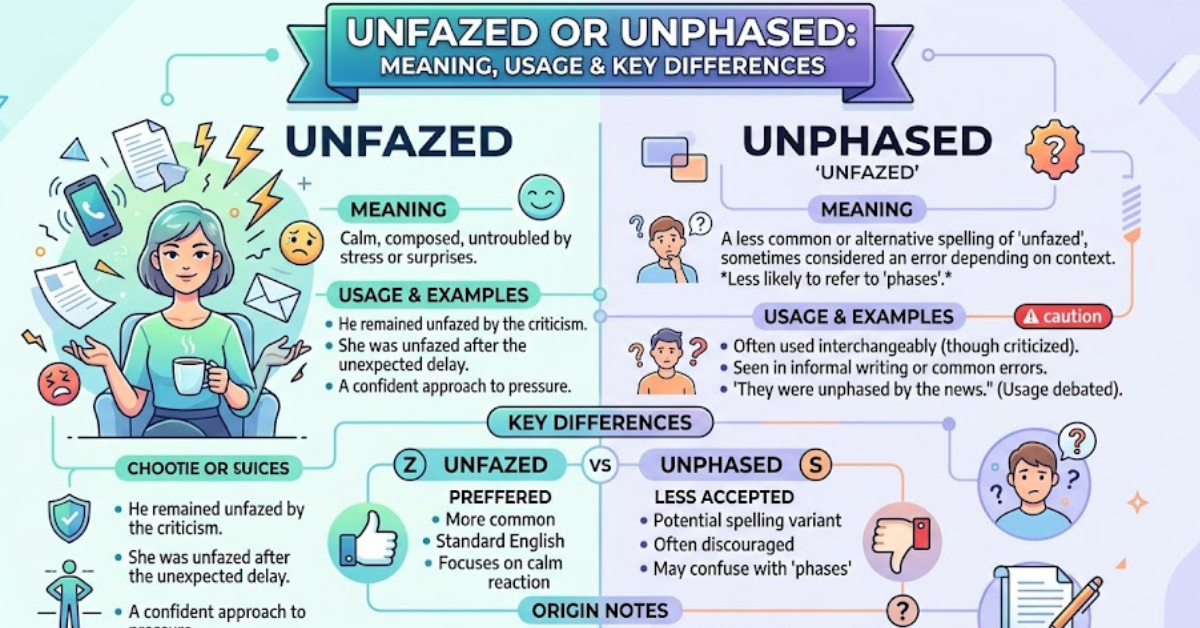
When people search for unfazed or unphased, they’re usually confused about which spelling is correct and whether both words mean the same thing. The short answer: “unfazed” is correct, while *“unphased” is often a mistaken variation—but it still appears widely in informal writing.
Understanding the difference between unfazed or unphased helps improve your grammar, writing clarity, and communication confidence. Let’s break it down in a simple, practical way.
What Does “Unfazed” Mean?
The word unfazed means not disturbed, surprised, or worried. It describes someone who remains calm under pressure or unaffected by something stressful or unexpected.
Examples of “unfazed” in sentences:
- She was unfazed by the loud noise during the presentation.
- Despite criticism, he remained unfazed and continued his work.
- The player looked unfazed after missing the penalty.
Common LSI keywords:
- calm under pressure
- emotionally steady
- unaffected attitude
- composed behavior
In short, unfazed reflects emotional stability and confidence.
Is “Unphased” Correct or a Mistake?
Here’s where confusion begins with unfazed or unphased.
The truth:
- Unphased is not traditionally correct in standard English.
- It is often a misspelling or misunderstanding of “unfazed.”
However, many people use unphased thinking it means “not affected by a phase or stage.” While that logic sounds reasonable, it is not recognized in formal dictionaries as the correct term.
Why the confusion happens:
- The word “phase” is common in English.
- People mistakenly assume “unphased” = not going through a phase or not affected by one.
But in proper usage, the correct word remains unfazed.
Unfazed or Unphased: Key Differences
Let’s simplify the comparison:
| Word | Correct Usage | Meaning | Formal English |
|---|---|---|---|
| Unfazed | Yes | Not disturbed or worried | Yes |
| Unphased | No (informal error) | Misused spelling of unfazed | No |
How to Use “Unfazed” Correctly
To avoid mistakes with unfazed or unphased, remember that “unfazed” always relates to emotional reaction.
Practical usage tips:
- Use it in emotional or psychological contexts
- Pair it with situations involving stress or surprise
- Avoid using it for scientific or technical “phases”
More examples:
- He stayed unfazed during the heated debate.
- The team was unfazed by early setbacks.
- She seemed completely unfazed by the rumors.
Why “Unfazed” Matters in Writing
Using the correct form improves:
- Grammar accuracy
- Professional communication
- Search visibility for content writers
- Reader trust and clarity
Common Mistakes to Avoid
Here are frequent errors writers make:
- Writing unphased instead of unfazed
- Confusing it with “unaffected”
- Using it in technical contexts where “phase” is literal
- Overusing it in repetitive sentences
Quick Memory Trick
To remember the correct form:
Unfazed = “fazed” (disturbed) + “un” (not) = not disturbed
Think: If nothing fazes you, you are unfazed.
FAQs About Unfazed or Unphased
1. What is the correct spelling: unfazed or unphased?
The correct spelling is unfazed. “Unphased” is commonly used incorrectly.
2. What does unfazed mean?
Unfazed means being calm, not worried, or not disturbed by a situation.
3. Why do people write unphased?
People confuse it with the word “phase,” but it is not standard English usage.
4. Is unphased ever acceptable?
It may appear in informal writing, but it is not considered correct in formal English.
5. What are synonyms of unfazed?
Some synonyms include:
- calm
- composed
- unbothered
- unaffected
Conclusion
The confusion between unfazed or unphased is common, but the rule is simple: unfazed is the correct and accepted form. It describes emotional steadiness and calmness in stressful situations, while “unphased” is generally a spelling error.
If you want clearer, more professional writing, stick with unfazed every time. It’s precise, widely recognized, and grammatically correct.
For stronger communication, focus on using accurate vocabulary like this—it instantly improves how your writing is perceived.