Have you ever paused mid-conversation wondering whether to say “I would love to” or “I would too”? You’re not alone. The phrase “I would love to or too” often confuses English learners and even native speakers because both expressions are common—but they are used in completely different situations.
Understanding this small grammar difference can make your English sound more natural, confident, and fluent. In this guide, we’ll break it down in a simple, practical way so you never mix them up again.
What Does “I Would Loves To” Mean?
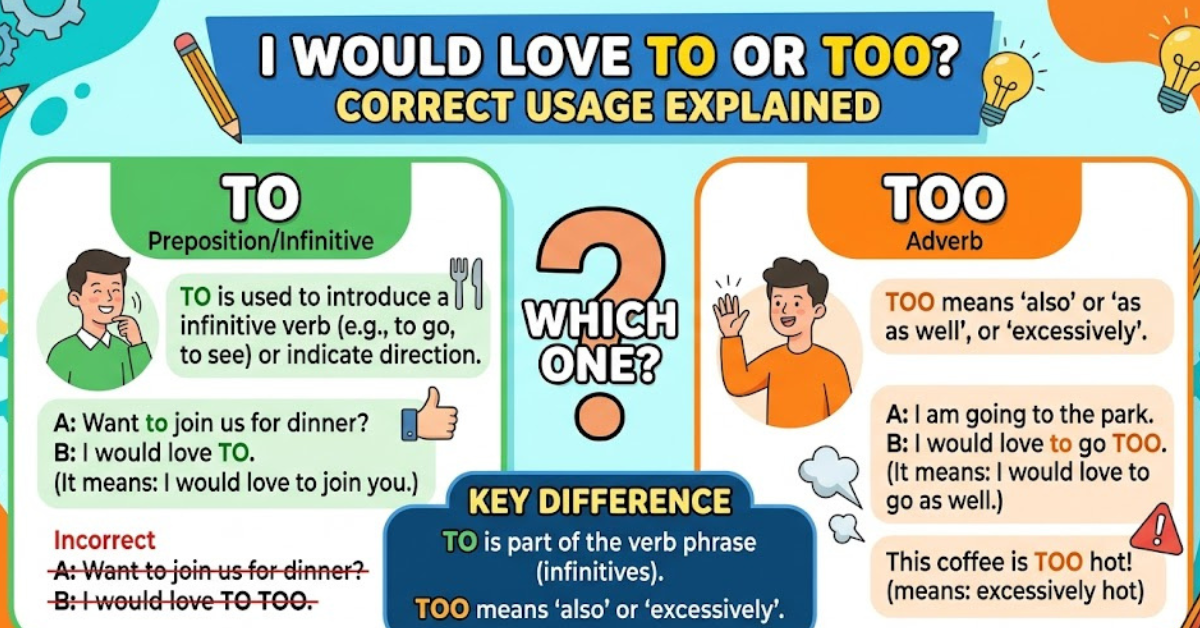
The phrase “I would love to” is used when you want to express enthusiasm or willingness to do something.
Usage Explained
- It shows interest or excitement
- It is followed by a verb (action)
Examples:
- I would love to travel to Japan one day.
- I would love to join you for dinner.
- I would love to learn guitar.
Key point: “I would love to” = expressing desire to do something.
What Does “I Would Too” Mean?
On the other hand, “I would too” is used to agree with someone’s statement or feeling.
Usage Explained
- It shows agreement
- It replaces a repeated idea in conversation
Examples:
- A: I love pizza.
B: I would too. - A: I would love to visit Paris.
B: I would too.
Key point: “I would too” = agreeing with someone.
I Would Loves To or Too: The Key Difference
The confusion comes from similar sounding structure, but their meaning is different.
Simple Breakdown:
- I would loves to → expresses your own wish
- I would too → agrees with someone else
Quick Comparison Table:
| Phrase | Meaning | Example |
| I would love to | Personal desire | I would love to go hiking. |
| I would too | Agreement | I would too (go hiking). |
Common Mistakes People Make
Many learners mix these phrases because they sound similar. Here are the most common errors:
Incorrect:
- I would love too go there.
- I would too travel abroad.
Correct:
- I would love to go there.
- I would love to travel abroad.
- I would too (if agreeing with someone).
Easy Trick to Remember
If you’re stuck between “to” and “too”, remember this:
- “To” = action (doing something)
- “Too” = also / agreement
A simple memory trick:
If you can replace it with “also,” use too.
If not, use to.
Why This Matters in Real English
Using phrases like “I would loves to or too” correctly helps you:
- Sound more fluent in conversations
- Avoid common grammar mistakes
- Improve writing for emails and messages
- Communicate clearly in professional settings
Even small grammar improvements can make a big difference in how natural your English sounds.
FAQs
1. Is it correct to say “I would loves too”?
No. The correct form is “I would love to.”
2. Can “I would too” stand alone?
Yes, but only when agreeing with someone else in conversation.
3. What is the difference between “to” and “too”?
- To is used before verbs (action words).
- Too means “also” or “in addition.”
4. Can I use “I would loves to” in formal writing?
Yes, it is widely accepted in both formal and informal English.
5. Why do people confuse “to” and “too”?
Because they sound the same when spoken, but their meanings and uses are different.
Conclusion
Understanding the difference between “I would love to or too” is a small but powerful step toward mastering natural English communication. Remember: “I would love to” expresses desire, while *“I would too” expresses agreement.
Once you get this right, your spoken and written English instantly becomes clearer and more confident. Keep practicing with real-life examples, and soon it will feel completely natural.